

What happened?
It was recently reported that a British Airways flight, an Airbus A350-1000, flew from Hong Kong to London, and a woman in her early 60s suddenly passed away in the cabin in the first hour of the flight. The flight continued for its full 14-hour duration with the body stored in a rear galley; however, because the galley had a heated floor, some passengers reported a foul smell during the remaining time of the flight.
I found the news astonishing. Putting myself in the passengers’ shoes, I would be distressed and potentially traumatised, not to mention the impact on the family members of the dead passenger who were also on board; how emotionally overwhelming would that be?
I recently flew from London to Athens and I heard the crew ask in the announcement, ‘Is there any doctor on board?’ Silent. After a few minutes, a lady stood up and, worriedly and anxiously, said out loud crying, ‘Please, is there any doctor? It is my partner. Please.’ Then a passenger walked towards her to comfort her, saying that everything is going to be alright. After a while, it looked like the patient got proper care and the situation seemed under control. But at that point, I thought if there is no proper doctor treatment for the patient, the pilot might have to decide if it is an emergency to land at a nearby airport.
In this news, British Airways claimed that following the protocol, since the passenger had already passed away, it was no longer an emergency. Therefore, flying back to Hong Kong was no longer mandatory. The crew, again claimed to be following the protocol, put the body on the floor of the galley.
What does the protocol say?
I am curious enough to check which rule they followed. See the screen cap of the relevant IATA protocol below:
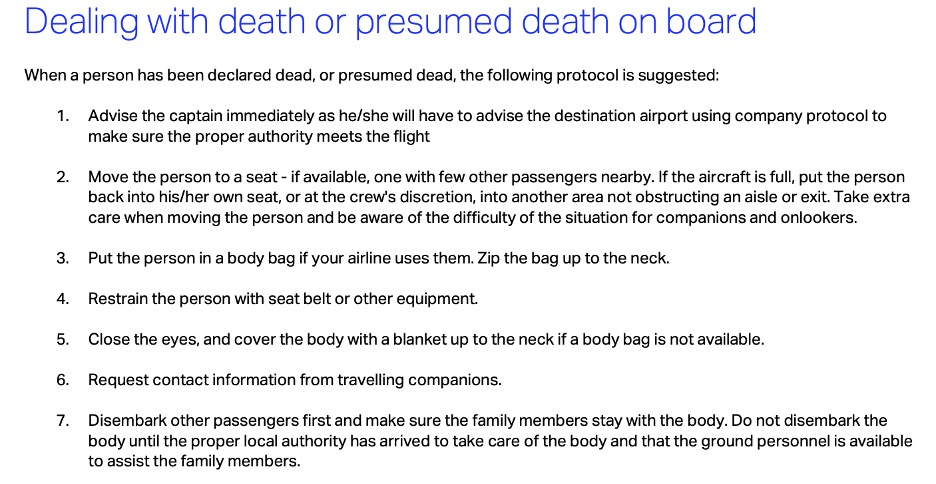
I was shocked to read the first option when the aircraft is full: ‘put the person back into his/her own seat.’ It continues, when a body bag is not available, ‘close the eyes, and cover the body with a blanket up to the neck.’ Who thought of this protocol? The mere image of this is spine-chilling. I believe this protocol needs urgent revision.
Apparently, this was not the crew’s first choice in the news. Instead, they went on to exercise their discretion and found ‘an area not obstructing an aisle or exit’, which in this case was the galley, which often cited as a common practice. However, A350 airplanes have had a floor heating function since they entered service in the mid-2010s. A dead body after 13 hours on a heated floor and the smell is like a constant reminder to the passengers.
Remedy for the passengers?
I am afraid my conclusion is that the remedy for passengers seems to be difficult. At first, I thought it could be argued that the crew was negligent in this incident: the crew has a duty of care to passengers in the cabin; they failed to meet the standard of reasonable care by placing the body on the heated floor for 13 hours, and the crew’s failure caused the harm; however, the difficulty is that pure emotional harm is rarely recognised as a qualified harm. Not to mention, Article 29 of the Montreal Convention explicitly states claims can only be brought subject to the limits of the convention, and Article 17 only recognises bodily injury. Therefore, unless passengers can prove bodily injury, I’m afraid there would be no remedy for passengers.
However, following the rule perfectly and causing no economic burden to the airline does not mean the practice is acceptable from an ethical or human dignity point of view. For the sake of British Airways’ public image, they could offer therapy for the passengers on board and consider financial compensation. On a practical note for future flights, there should be a proper bag for bodies on every airplane. If putting a body in the galley is a common practice as a last resort, and since some airplanes have heated floors, then a proper bag should be mandatory equipment on board.