On 10 December, I tuned into a webinar organised by the Music Business Association, delivered by Maria Garrido, CMO of Deezer, about their market research on AI music. The recorded webinar will be available on the Music Business Association’s website.
Maria said that 34% of music uploaded to their platform is now AI-generated. Their survey covered eight countries (Canada, the United States, the United Kingdom, France, the Netherlands, Germany, and Brazil), with 9,000 people from the general population aged 18–55, not experts. They found that 97% of people can’t tell the difference between fully AI-generated and human-made music. The figure is slightly better in the UK, where 95% of people still can’t tell the difference.
I was surprised by the figure, although not too surprised. Our band was recently rehearsing two songs, and when I listened to them, I had no clue they were generated by AI. I only found out later when I tried to find drum sheet music online. I am among the 95% after all.
I think Deezer is doing a good job by tagging AI-generated music, so users can make their own decisions. Deezer also makes sure that fully AI-generated tracks do not go into playlist pools.
Beyond platforms, major labels are also adjusting their approach. Universal and Warner have reached deals with AI music platforms including Suno and Udio. I feel this shows a mindset of ‘if you can’t fight something, join it’. At least through these arrangements, Universal and Warner can make sure Suno and Udio follow certain rules.
At the user level, I was recently asked by an entrepreneur friend whether they could use music made with Suno for marketing purposes. I checked Suno’s website and found that paid users are allowed to use the music for commercial purposes, while free users are not. I attach a screenshot of Suno’s terms as they appear on its website today (24 December), as these terms may change in 2026 after arrangements with Warner.
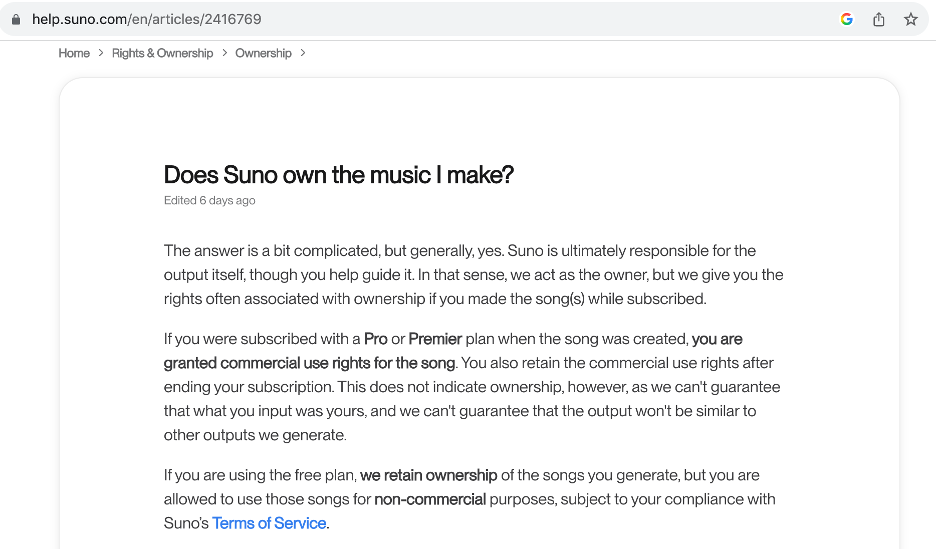
However, this only answers half of the question. How does Suno have the right to confidently say whether users can use the music or not, when AI works’ authorship is still a debatable issue? Traditionally, copyright requires human authorship. Under US law, purely AI-generated works cannot be copyrighted because they lack human authorship. This position is reflected in the US Copyright Office’s report on the legal and policy issues related to copyright and AI, released in January 2025. In March 2025, the US Court of Appeal also supported the Copyright Office’s rejection of Dr Stephen Thaler’s request to register a copyright claim for an AI-generated picture titled A Recent Entrance to Paradise.
In the UK, however, under Section 9(3) of the Copyright, Designs and Patents Act 1988 (CDPA), AI-generated music is still eligible for copyright. The author is defined as the person who made the arrangements necessary for the work’s creation.
Despite this existing legal position, academics have argued that a sui generis right with a shorter protection period may be more appropriate, considering AI development and incentive needs. Who should own this right remains debated. There are two main schools of thought:
(1) the ‘proximity approach’, which focuses on the person or entity most closely associated with the creative output, such as the AI project arranger, coder, goal selector, data selector, trainer, or output selector; or
(2) the ‘investment approach’, which assigns ownership to the natural or legal person who made the arrangements necessary for the creation of the work.
From a legal certainty perspective, the investment approach seems more favourable. This area is still under reform, and the UK government is expected to publish its response by 18 March 2026, following a consultation that closed in February 2025. I have also had the opportunity to speak with a UKIPO officer at the Council of Music Makers Christmas party on 2 December, who has been reviewing the large volume of consultation responses. I look forward to seeing the outcome.